Philips Philicorda · Volume 6
Sound, Players and Plugins
What a Philicorda sounds like and why, who is documented as playing one, the claims that do not hold up, and the software that models it
The Philicorda was sold as a home organ. Its second life began when bands went looking for cheap, characterful combo organs and found one with a deep spring reverb, a vibrato that moves every octave together, and a tone made from sawtooth waves. This volume describes the sound in terms of the circuit, lists the musicians who are actually documented as using one, flags some widely repeated claims that could not be verified, and describes the two software instruments built from it.
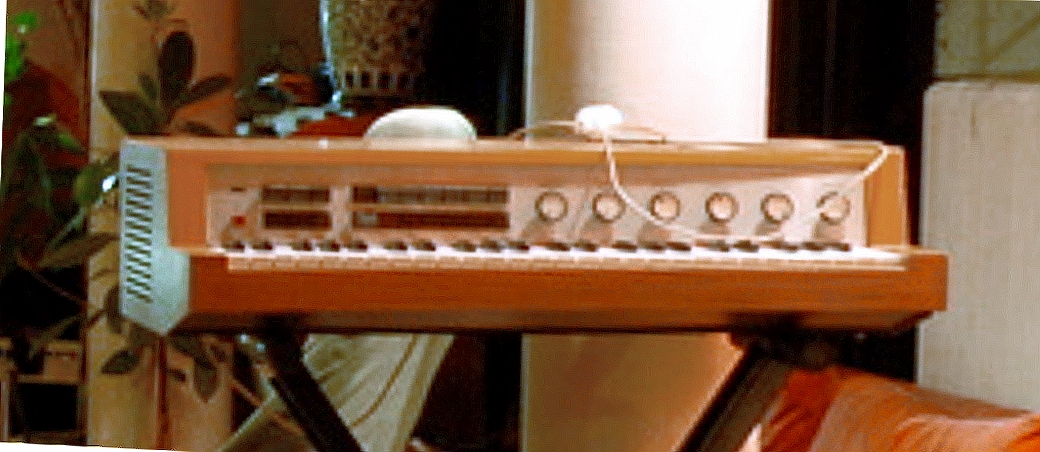
6.1 Where the sound comes from
The voice of a neon-divider Philicorda can be traced through the signal chain of Vol 2.
- Sawtooth sources. Every divider stage puts out a sawtooth (Vol 3), a waveform that contains every harmonic of its note. The five Vox filters shape that raw material by removing harmonics.
- Footages. The 8′, 4′ and 2′ tabs add the same note one and two octaves up. Because all three come from one master oscillator through locked dividers, they are perfectly in tune with each other, and their sawtooths are phase-locked.
- Vibrato at the source. The 5–6 Hz vibrato modulates the twelve masters, so it is a true pitch vibrato and moves all the octaves of a note together (Vol 2).
- Spring reverb. In the AG7600 amplifier for the AG7500, and built in from 1965 onwards.
- Keyed audio. Notes start and stop as fast as the key contacts close, with no attack shaping.
How much the neon dividers themselves contribute, beyond producing sawtooths, is a matter of opinion. The sibling Neon Ring Counters dive and several enthusiast pages describe a “warm, faintly unstable” voice and attribute some of it to the neon stages. A locked stage adds no pitch error (Vol 4), but small variations in exactly when each stage fires would add some jitter to the waveform; whether that is audible through the filters has not been measured for this dive.
6.2 Players
Only a few uses are documented first-hand. The table grades each claim by its evidence.
Table 1 — Players
| Who | Claim | Evidence |
|---|---|---|
| Teenage Fanclub | Norman Blake says the band used a Philicorda “extensively” on the album Shadows (2010), and calls it “super versatile with cool vibrato and badass reverb” | First-hand: interview in Magnet |
| The Coral | Rediscovered the organ in the 2000s | Two sources: a Sound On Sound review and the English Wikipedia |
| Adele, Ellie Goulding | Philicorda on their recordings | Two sources, the same two; no album credit found |
| Hanns Dieter Hüsch | The German cabaret artist played one on stage for decades | English and German Wikipedia, the German article citing a brand eins feature |
| The Monks | Their organist Larry Clark used a Philicorda in the 1960s | English Wikipedia only, uncited |
| Chris Montez, “Let’s Dance” (1962) | Ray Johnson played a Philicorda on the record | Doubtful — see below |
The German and Dutch Wikipedia articles name further players, among them Locas In Love, Kaufhaus Dahl, Danny Dziuk and the Dutch organist Bert van den Brink, each on a single source.
“Let’s Dance”. The English Wikipedia’s article on the song says Ray Johnson played a Philicorda on it, citing a 2011 book, and Hackaday repeats the claim. The record was made in Los Angeles in 1962. The Philicorda went on sale in the Netherlands at the beginning of 1963, and its only earlier version, the 1961 AG7400, is described by the Dutch and German Wikipedias as a prototype. Ace Records’ notes on the recording say only “Ray Johnson on organ” (Ace Records). Unless a primary source turns up, the claim should be treated as unlikely.
Claims with no evidence. Stereolab, Air, Broadcast and Joe Meek are sometimes mentioned in connection with the Philicorda. No source was found for any of them, and the sources found for Stereolab and Broadcast name a Farfisa. Equipboard, a user-edited site, lists Clinic, The Cardigans and The Soundtrack of Our Lives; those listings are unverified.
6.3 Software
Two instruments model or sample a Philicorda. Both are based on the transistor generation, not the neon-divider organs.
- AudioThing Philicorda — a modelled instrument (with sampled reverb and speakers) based on an all-transistor GM751, released in January 2024 as a plug-in in the common formats and for iOS (AudioThing; KVR announcement).
- Samplephonics Sonas — a sample library for Native Instruments’ Kontakt, recorded from a GM751 and a GM752, reviewed by Gordon Reid against his own GM754 in Sound On Sound.
No Philicorda was found in the combo-organ collections of GForce, Arturia, Native Instruments or Spitfire, or among free plug-ins.
Sources
Primary
- Philips, Service, Philicorda 22GM751/00/10/15/16/17/19/22/30/32/40/43/50, German, 22 pp., 1967. Scan hosted by Åke Holm, SM5CBW; also in this site’s Reference Library.
- Philips, ZA1002 data sheet, 1969/1979: frank.pocnet.net.
Instrument and tube references
- radiomuseum: AG7500, AG7600, ZA1001.
- SMEM (Swiss museum of electronic music instruments): AG7500, GM752.
- R. Nickel, Philicorda AG7500, drummachines.de.
- wernbo.de, Philips Philicorda 7500.
- Ronald Dekker, neon ring counters and the ZA100x tubes, dos4ever.com.
- tubedatabase: Z70U, ZZ1000; lampes-et-tubes.info: ZA1000.
- Wikipedia: English, Dutch, German.
- combo-organ.com, Philips; Chicago Electric Piano, combo organ feature.
Repair accounts
- Circuits Online threads 116294 (22GM751 dividers), 154066 (GM752 oscillator), 148173, 87746, 78678, 70321.
- GroupDIY threads 12376, 16139, 32936.
- Liquitone, Philicorda AG-7500.
Sound and culture
- Magnet, “A Teenage Fanclub Education: Philips Philicorda Organs”, 2010.
- Gordon Reid, review of Samplephonics Sonas, Sound On Sound.
- Jenny List, “The Organ That Forgot To Use Transistors”, Hackaday, 3 July 2026.
- AudioThing, Philicorda.
Comments (0)